
A gaming cafe is a floor of shared PCs, a timer, an attendant who is also restocking drinks, and an egress IP that every booth shares. That IP already has a reputation, good or ugly, with game platforms, anti-cheat, and whoever else scores datacenter-adjacent NAT. A VPN can give the shop a branded client and a different egress. It can also leave a tunnel up on the next customer's session, fight UDP through cafe NAT, and teach players that the house 'reduces ping.' That last sentence is how you buy a chalkboard lie you cannot keep.
This is not the consumer article about whether a VPN causes gaming lag. That page exists for a person on a home connection choosing a server. This page is for the owner, the chain ops lead, or the vendor putting the cafe name on an app. Shared machines. Session accounts. Who pays. What you print above the front desk. The hotel amenity article is a cousin (captive portal, short-lived credentials). The cafe is meaner: competitive clients, overlays, leftover processes, and a customer who will smash a keyboard if the queue popped.
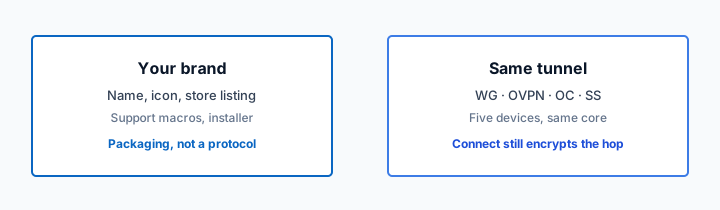
White-label means the icon says the shop or the chain, not a platform name. Reseller leaves the upstream brand. Most cafes that care about the relationship want the name on the tower to match the name on the phone. That is white-label. Confirm the package with sales. Do not screenshot a five-device family checkout onto a booth rate card.
KloxVPN's consumer SKU is WireGuard, OpenVPN, OpenConnect, and Shadowsocks, five devices, from $2.83/month on yearly, 7-day money-back. A cafe should not quote that as a per-hour add-on. Session length, seat versus shop license, and who answers when a launcher hates the exit are a sales conversation. I will not invent an SLA percentage. I will not invent city counts. I will not invent an anti-cheat partnership. I will not publish API URLs. The consumer site talks 60+ countries and 100+ locations. Your footprint is the contract.
Cloudflare and Wikipedia still explain a tunnel to a new attendant. RFC 8446 is TLS 1.3 on the web path, which is not your game UDP. NordVPN's consumer gaming pitch is a traveler buying a personal plan. Do not paste it onto a chalkboard. You are selling to the shop. Insulting the house network in the house voice is how the owner kills the project after one weekend of complaints.
Related reading: How to Use a VPN on Risograph Wi-Fi and White-Label VPN and Debian Ppa. White-Label VPN and Decap Cms and White-Label VPN and Decap on a branded site. What is a VPN? and Reseller program.
Looking for a reliable VPN?
KloxVPN — from $2.83/month. Apps for every device.
Shared PCs are not a family plan
Family plans assume a household, a credit card, and a person who lives with the device list. A cafe PC assumes a stranger every hour, a ghost profile, Discord still logged in if you were sloppy, and a tunnel that will outlive the booth if you do not kill it. If your onboarding PDF starts with create an account, you are not in the cafe business. You are in the consumer-VPN business with a worse hourly rate and a sticky keyboard.
Write the offer in cafe nouns. Booth. Session. Timer. Image. Attendant reset. Shop egress versus player egress. If your deck still says unlimited blazing servers, you leaked a consumer landing page onto a floor that sells time. The owner will smile and then ask who they call when Valorant will not open. If that slide is fuzzy, you will eat the weekend unpaid. Cafe owners hate unpaid weekends. They should. Weekends are the P&L.
A VPN wraps packets. It does not wipe the Windows profile. It does not close Steam. It does not make anti-cheat like you. Package the session first. The tunnel is a line item on top of a floor you already know how to run, or you should not be selling this.

- 1Skim the seating / order diagram.
- 2Do the numbered steps once on your real network.
- 3Use the FAQ if a sentence was too long.
- 4Follow one related article — not ten tabs.
How to read this page
| Package | Who pays | Credential life | Failure mode |
|---|---|---|---|
| Shop-paid house tunnel | Owner, in the hourly rate | Machine session, dies on image reset | old process after a dirty reboot |
| Player opt-in add-on | Player, at the desk or in the launcher | Booth timer plus a short grace | Attendant cannot reset at 11pm |
| Chain-branded app on phones | Player, off the floor | Until they cancel | You taught them to skip the cafe |
| Consumer 5-device checkout | Whoever typed the card | Until they cancel | You put a family SKU on a shared PC |
If the next customer inherits the last customer's tunnel, you did not build a cafe VPN. You built a old.
— KloxVPN operator notes
Cloudflare Learning: What is a VPN?
Wikipedia: Virtual private network
NordVPN (competitor consumer gaming pitch — wrong aisle for a cafe floor)
The image is the product
If the cafe already reimages or resets a profile at session end, the VPN client has to live in that ritual. A per-user install that survives the reset is a ghost. A per-user install that dies but leaves a TAP adapter in a weird state is a Monday ticket. Put the client in the image. Put disconnect in the reset script. Then test it like a game launch, not like a slideshow.
Phones on cafe Wi-Fi
Players will join the house SSID on a phone and expect the same story. That is a different SKU: BYOD, captive portal, kill switch fights. The hotel article is that wound. Do not pretend the tower image covers the phone. If phones are in scope, write them. If they are not, say so on the chalkboard so you do not debug a personal always-on client at the desk.
Session accounts that die with the timer
I like credentials that die when the booth dies. A machine-local session. A voucher that expires with the paid minutes plus a grace window you chose on purpose. Permanent emails for a two-hour visit become a graveyard and a privacy headache. If the cafe already has a POS session ID, bind to that. If it does not, time-box and accept that a crashed timer needs an attendant reset. Pick the failure you can staff.
Checkout is a disconnect. Not a disable we will get to. If a player can still use the shop tunnel from the bus on a token tied to booth 12, you did not build hospitality. You built a hole. Automate the kill off the session event. If the session event is flaky, kill on idle and on image reset. Two kills beat one hope.
Klox consumer five-device is the wrong mental model on a floor of forty towers. Confirm the cafe SKU. If the shop buys a site-style package, say so. If each booth is a seat, say so. Caps discovered when a tournament laptop pile shows up are tickets with an audience and a bracket.
Grace windows
Matches run long. Timer hits zero, tunnel dies, player is in an unranked disaster. A two-minute grace is cheaper than a scene at the desk. A two-hour grace is how last booth's session is still on your nodes. Write the window. Tell the attendant. Do not leave it as whatever the vendor defaulted.
Tournaments
A Saturday bracket is not a casual booth. You may want the tunnel off entirely so anti-cheat and LAN see the house path. Write a tournament mode: disconnect, disable autostart, attendant checklist. Mixing tournament PCs with casual VPN defaults is how you get a DQ argument you cannot win.
UDP and WireGuard on cafe NAT
WireGuard is UDP. Cafe NAT is often cheap, crowded, and already doing something cute with timeouts. That can be fine. It can also drop mappings mid-round. OpenVPN as a TCP fallback inside the branded app is how you survive a middlebox. OpenVPN as an attendant ceremony (import a profile, hunt a .ovpn on the desktop) is how you lose the shift. Keep the protocol. Kill the ceremony.
Test on the real floor. Not on a home fiber. Forty machines, one public IP, game UDP plus voice plus the tunnel UDP is a different shape than a laptop in a bedroom. If WireGuard dies at 7pm every Friday, you have a NAT or an ISP story, not a 'VPN is slow' story. Split the diagnosis or you will buy the wrong fix.
IPv6 on cafe Wi-Fi, if it exists, will leak around a sloppy client. If the shop disabled IPv6, say that so you do not chase a ghost. If it is on, test it. Dual-stack surprises are a Monday forum thread.
Voice and overlays
Discord, TeamSpeak, overlays, kernels that already hate you. A tunnel can break voice while the game still plays, or the reverse. Split-tunnel voice if you tested it. Do not promise 'everything just works' on a chalkboard. Promise a default you measured on that image.
Captive portal on guest Wi-Fi
If the cafe has a guest SSID with a splash page, the phone path has the hotel problem: portal first, tunnel second. Fail-closed on a guest phone is a desk ticket. Default student-amenity humility here too.
Cafe Wi-Fi reputation is a shared-egress problem
Every booth already exits through the same house IP most of the day. Platforms see a busy NAT. Sometimes they throttle. Sometimes they challenge. Sometimes a neighbor booth got someone banned and the IP is now interesting. A branded VPN is a way to present a different egress. It is not a reputation washer you can promise. If the new exit is shared with random consumer traffic, you may have bought a worse neighborhood.
Dedicated IP, if your package includes it, is a shop tool: a named egress you can ask a platform about, or at least stop sharing with the whole consumer pool. It is not anonymity. It is the opposite. The White-Label VPN and Dedicated Ip Sla article is the general sales-tool version. Here: the owner needs to know whether the house IP is already in trouble before they add a second identity. Two bad identities is not a strategy.
I will not invent a city list. I will not invent a cleanliness score. If a platform blocked you, collect the timestamp and the error, then talk to sales about assignment. Blog claims will not unban a /32.
Do not sell 'unban'
If a player is banned, a new IP is not a product feature you should print. That is how you become a circumvention shop. Sell a house path and a known egress. Leave account status to the platform.
Downloads and launchers
Steam, Epic, battle.net on a tunnel can be slower, faster, or blocked. Test the launchers you actually install. Put the result on the attendant card. Surprise at 8pm is a refund on the hour.
Who pays: shop versus player
Sometimes the owner pays, as cost of goods, because the house IP is painful and they want a quieter egress in the rate. Sometimes the player pays, as an upsell at the desk ('plus VPN for this session'). Sometimes a chain bills stores a monthly and forbids desk upsells. Write it. If who pays is TBD, the attendant will guess, and guesses become fights when the receipt looks wrong.
Player-paid sessions need a price the desk can say without flinching, a button that issues a session, and a reversal rule when the tunnel was down. If you sold the add-on and the launcher still hates the path, you will eat a desk fight. Write the reversal. The consumer 7-day money-back is the wrong policy on a two-hour booth. Confirm how reversals work in your package.
Shop-paid is simpler at the desk and harder in the P&L. You will be asked to prove it changed anything. Pick a metric that is not ping: launcher-challenge rate, desk tickets tagged VPN, session-reset failures. If you cannot measure, you cannot defend the line to a chain CFO.
Do not run three prices on day one
One primary path. A tournament exception. That is enough. Three SKUs with three expiries is how the attendant sells the wrong one and the next shift cannot unwind it.
Chain versus single shop
A chain wants one image and one contract. A single shop wants something that works this Friday. Do not sell the chain theater to a one-location owner. Do not sell a one-PC experiment to a 40-site brand as if it were a rollout.
This is not a reduce-ping consumer clone
We already published VPN for Gaming: Does It Cause Lag?. Extra hop, WireGuard overhead, pick a server near the game. That advice is for a person who controls their last mile. A cafe owner does not need a lecture about milliseconds as a marketing promise. The extra hop can add delay. It can also avoid a sick ISP path. You will not know until you measure on that floor, on those games, at 7pm.
Do not print lower ping on the chalkboard. Print optional path, session-based, attendant can reset. If a player asks about ping, tell them the truth: it depends, we can toggle, we will not refund on a feeling. If that loses the upsell, it lost an upsell that would have become a review about lag, not about the shop.
Competitive players will A/B the tunnel in one death. Your default should be off unless the house IP is known-bad for that title. Opt-in per session beats always-on on a tournament weekend.
What to measure instead
Connect success. Time-to-play after sit-down. Launcher errors. Voice failures. Session leftover rate (tunnels still up after reset). Those are operator numbers. Ping is a player religion. You can log ping. Do not sell it.
Server picker on a shared PC
A free-for-all region picker is how booth 7 is in a city that makes no sense for the match. Pin a default. Hide the picker or lock it. Power users can ask the attendant. Forty pickers is chaos.
Attendant scripts: ninety seconds, three steps, a stop
The attendant is not your NOC. They are checking in a walk-in, swapping a headset, and watching a door. Your VPN cannot require a personality. Give them a card.
Step one: is this a shop-paid house path or a player add-on. If add-on, is it on the ticket. Step two: reconnect once. If the image has a desktop shortcut, use that. Do not hunt settings. Step three: still dead? Collect booth number, time, title, and whether a personal VPN or overlay is also running. Then stop. Escalate to shop IT or the platform path you wrote. Do not import profiles. Do not download a random app from a search result onto a shared PC. That last one is how you get malware with a logo.
If the answer on the card is install OpenVPN Connect, you already lost Saturday. Translate the card. A floor has more languages than your HQ. You do not need twenty on day one. You need the languages the desk already uses for prices.
What the attendant must never do
Promise a ping. Disable anti-cheat. Type a platform password into a player's account. Factory-reset mid-match without a script. Those four create bans, chargebacks, and folklore. The card should say never as clearly as it says the steps.
Shift briefing, not a training day
You get ninety seconds in a standup. Demo connect. Demo reset. Demo tournament-off. Done. A two-hour LMS module will be skipped. Skipped training plus a live add-on is a meltdown you scheduled.
Launchers, leftovers, and the next customer
The failure I care about is leftover state. Tunnel up. Steam still in the last account. Overlay hooked. Next customer inherits a path and an identity. Your reset must include: disconnect VPN, kill client process, wipe or switch the Windows profile the way you already do. If the cafe's reset is 'next' on a timer and nothing else, fix that before you add a tunnel. A tunnel on a dirty profile is a privacy incident with a receipt.
Drivers: TAP or WireGuard NT can survive a sloppy reboot in a weird way. Test dirty reboot, power pull, and the actual reset tool. If a machine needs a human after a pull, you will not have enough humans at 8pm.
Logging on the machine: if the client writes logs to a world-readable desktop, the next customer can read them. Put logs where the image wipes them, or disable verbose logging on the floor SKU.
Account mixing
A branded VPN login that is 'the cafe account' on every tower is simple and also a blast radius. Prefer machine-session tokens. One leaked password should not be forty booths. If you must share a shop account, rotate it on a calendar and treat it like a POS admin password.
USB and BYO laptop
Some cafes allow BYO laptops on the SSID. That is the hotel problem plus a competitive client. Decide if BYO is in scope. If yes, QR to a player SKU with a timer. If no, say no. Half-yes is a desk argument.
Front desk versus shop IT versus platform
Desk owns: which package, issuing and resetting session codes, folio/receipt questions. Shop IT owns: image, SSID, NAT, reset script, whether IPv6 is on. Platform owns: handshake failures, client defects, node-side incidents. Shared: 'the game banned me' and 'ping is high.' Shared is a fight unless you timebox it. Ban tickets are not yours. Ping feelings are not yours unless you sold ping. Stop selling ping.
The player should not see three teams. They see the shop. Escalation is back-office. If you SMS a platform name, you taught them to skip the cafe. White-label means the shop owns the relationship. If that scares the owner, they wanted a consumer QR. That is reseller energy. Most floors will not accept it on the tower wallpaper.
Write the split in the SOW. Review tickets per 1,000 paid hours with the amenity, not per 1,000 consumer subs. Cafe mix is leftover tunnel, launcher errors, portal fights on phones, and a thin tail of real handshakes. If handshake is the bulk, your NAT or your UDP default is sick.
After-hours
If shop IT is the owner sleeping, the honest script is disable and offer the house path, then a callback. Lying about 24/7 engineering will be discovered during a LAN party and remembered in the group chat.
The hotel cousin
Short-lived credentials and portal order are the same ideas as Hotel-Branded VPN: Guest Wi-Fi Without a Front-Desk Meltdown. Do not copy the night-auditor card onto a cafe. The titles, the anti-cheat, and the leftover Steam account are the difference. Steal the humility, not the script.
Procurement for a floor, not a homepage
A chain RFP will ask for SLA, cities, SOC 2, and a ping guarantee. I will not put those on this page. Answer what you can verify. Forward what only the platform can verify. Start with one shop, one image, one title you care about, an end date, a leftover-tunnel metric. Heroic 40-site rollout in a holiday week is how you get a Slack channel named vpn-fire while the POS is already on fire.
Who is merchant of record if the player pays? If it is on the cafe receipt, the cafe is in the tax path. If it is in an app, you are. Pick it. The billing article is the general wound. Here: a two-hour session refund is not a 7-day consumer window.
White-label is the platform conversation. Contact is the meeting. Consumer pricing is the wrong sheet. If they wanted a personal plan from $2.83/month, send them to pricing. This aisle is for a floor that already sells time.
When to walk
They need you to promise unbans, lie about ping, or staff a night desk you cannot staff. There are other shops. There is not another reputation.
The chalkboard test
Read the board out loud. If it says lower ping, anonymous, or unblocks everything, rewrite it. If an attendant cannot follow it in ninety seconds, rewrite it. WireGuard can stay. The board has to stay human.
What you must not write on the chalkboard
Do not promise lower ping. Do not promise anti-cheat bypass. Do not promise unbans. Do not promise anonymity on a camera-covered floor. Do not promise five devices if the cafe SKU is a machine session. Confirm with sales. Do not promise WireGuard will pass every NAT. Offer OpenVPN in the app. Test both at 7pm.
Do not promise 24/7 engineering if the night path is the owner. Do not put a consumer QR that teaches players to skip the shop. Do not leave the last session's tunnel up. That last one is the whole product.
If this still sounds like your floor, bring a real package: who pays, image reset, timer hook, titles you care about, phone in or out, tournament mode. Leave the ping slogan at the door.
Pilots that never end
End date. Metric: leftover tunnels per 1,000 hours, launcher errors, desk resets. No metric, no chain rollout. I have been the free add-on. It is a lousy identity.
Kids on the floor
If the cafe allows minors, your session logs, cameras, and leftover accounts are a different legal pile. Counsel owns that. A VPN does not make it simpler. Do not use the tunnel as a 'safety' story for parents. That is a sentence you will hate in writing.
Key Takeaways
A cafe-branded VPN is a session path that dies with the booth timer, lives in the PC image, and can be reset by an attendant in three steps. It is not a family plan and it is not a reduce-ping consumer essay. House path or player add-on — pick one primary. WireGuard on clean UDP, OpenVPN when the NAT is rude. Dedicated IP only if you have a reason that is not a chalkboard.
KloxVPN can put the shop name on that pair. You still have to package the hour like an operator. Session length, who pays, and leftover-kill are a sales conversation. Confirm them. Do not paste a five-device consumer SKU onto a tower and call it a floor product.
If you needed the consumer lag page, it exists. If you needed the hotel amenity cousin, it exists. This one is the timer. Bring the image and the attendant card. Leave the ping religion at the door.
Related Resources
Put a cafe name on a session tunnel the attendant can reset
White-label apps, WireGuard, OpenVPN, OpenConnect, and Shadowsocks, and a packaging talk for shared PCs. Confirm session length and SKUs with sales. This page is not a ping guarantee and not a rate card.
See white-label VPNFrequently Asked Questions
KloxVPN Team
Experts in VPN infrastructure, network security, and online privacy. The KloxVPN team has been building and operating VPN services since 2019, providing consumer and white-label VPN solutions to thousands of users worldwide.