
HTTPS locks the content of many sites, but the hotspot can still learn a lot about your session until a VPN is up. Think of the VPN as an encrypted envelope around everything you do after Connect.
Klox costs $2.83/month on the yearly plan, covers five devices, and offers 7-day money-back on your first purchase. There is no secret "Campus Guest mode" in Settings — the same app you use at home is the app you use here.
People search "Campus Guest VPN" when they mean "I am on someone else's network." This guide walks through that situation in plain language: finish the login page, connect Klox with WireGuard, OpenVPN, OpenConnect, and Shadowsocks, and know what the network can still see.
Looking for a reliable VPN?
KloxVPN — from $2.83/month. Apps for every device.
Why Campus Guest Wi‑Fi needs a VPN habit
Remember five devices on your plan — seat phones, tablets, and laptops intentionally.
On shared Wi‑Fi, other clients may snoop broadcast traffic. The operator may inject ads or use an outdated captive portal. You rarely know who patched the firmware last.
A VPN sends your traffic through an encrypted tunnel to a server you pick. The local network sees ciphertext headed to that server — not your full browsing trail inside the tunnel.
Travel teaches the same lesson repeatedly: the SSID name is not a security guarantee. Treat every guest network as untrusted until you are home.
Yearly billing at $2.83/month on the yearly plan is often cheaper for frequent travelers; 7-day money-back on your first purchase lowers the risk of trying it on one trip.

- 1Join the SSID. Do not start the VPN yet.
- 2Open a browser and finish the captive portal.
- 3Open Klox. Connect WireGuard.
- 4If the handshake dies, switch to OpenVPN. Then work.
Do this in order
| Setting | Who runs the LAN | Usual gadget | Consumer VPN habit |
|---|---|---|---|
| Eduroam / campus 802.1X | The university, federated | Student or staff device they issued | Eduroam essay owns RADIUS. Do not steal those credentials. |
| Campus VPN (ITS product) | The university | A later hop for journals | Not Klox. Not this URL. ITS owns that tunnel. |
| Dorm / housing LAN | Housing or ITS | A jack, a roommate, a printer | Dorm article; you do not live here |
| School / district SSID | The K-12 district | Student or staff device | School article owns the filter and the AUP you may not hop |
| Conference / badge hall | The organizer | Phone on a lanyard | Conference article; exhibitor SSIDs you do not steal |
| Campus guest / visitor SSID | The university | Your phone, a nametag | Guest page, then tunnel if the AUP allows it |
| Staff / ResNet / housing SSID | ITS or housing | Their till, cameras, resident kit | Not yours. Do not join it. Guest Wi-Fi or cellular. |
| Admissions lobby kiosk | The university | Glass you do not own | Prefer your phone. Do not install. Public-PC lesson still applies. |
Klox is a hop you chose. It is not eduroam, not ITS, and not a license to use credentials you were not issued.
— KloxVPN consumer notes
Cloudflare Learning: What is a VPN?
Wikipedia: Virtual private network
What HTTPS already covers
The padlock in your browser still matters. TLS protects the page. The VPN adds a layer for everything that leaves your device, including DNS and non-HTTPS apps.
If you work remotely, split work VPN and personal Klox deliberately. Two tunnels at once cause routing pain.
What a VPN does not fix
It does not stop you from logging into a phishing site or sharing your password. It helps with network privacy, not judgment calls.
Travel teaches the same lesson repeatedly: the SSID name is not a security guarantee. Treat every guest network as untrusted until you are home.
Captive portal first, VPN second
Teach family members the portal-first rule once. They will call you less often when hotel Wi‑Fi "breaks the VPN."
If the page loops, disconnect the VPN, reload the portal, then connect again. That fixes most "Campus Guest VPN broken" reports.
Travel teaches the same lesson repeatedly: the SSID name is not a security guarantee. Treat every guest network as untrusted until you are home.
Yearly billing at $2.83/month on the yearly plan is often cheaper for frequent travelers; 7-day money-back on your first purchase lowers the risk of trying it on one trip.
Order: join SSID → open browser → finish login or accept terms → open Klox → Connect. Captive portal basics goes deeper without repeating a full tutorial here.
Kill switch note
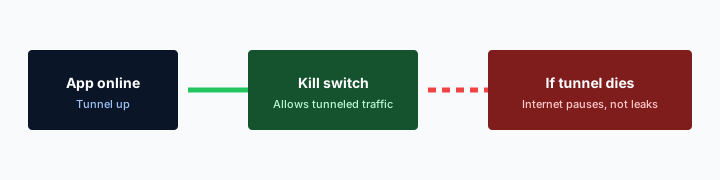
A kill switch that blocks all traffic can fight the portal. Pause the VPN until the portal succeeds, then reconnect with the kill switch on if you need it.
Keep the Klox app updated before trips. Store policies and OS changes affect VPN permissions more than venue names like Campus Guest.
Paid vs free guest Wi‑Fi
Some Campus Guest setups ask for payment or a room number. Complete that step on cleartext Wi‑Fi first; tunnel afterward.
Public Wi‑Fi is optional. Mobile data plus VPN is sometimes the saner choice in crowded venues.
WireGuard vs OpenVPN on this network
Keep the Klox app updated before trips. Store policies and OS changes affect VPN permissions more than venue names like Campus Guest.
If both fail, the network may require browser-only access or block VPN protocols entirely. Try mobile data as a fallback for critical work.
Public Wi‑Fi is optional. Mobile data plus VPN is sometimes the saner choice in crowded venues.
If you work remotely, split work VPN and personal Klox deliberately. Two tunnels at once cause routing pain.
If WireGuard stalls on Campus Guest Wi‑Fi, switch once to OpenVPN in the app and retry. Do not install extra VPN clients.
One swap rule
WireGuard → OpenVPN → stop. More swaps rarely help and waste time.
Teach family members the portal-first rule once. They will call you less often when hotel Wi‑Fi "breaks the VPN."
After it connects
Run a quick DNS leak test if you handle sensitive work on a hotel lobby.
Remember five devices on your plan — seat phones, tablets, and laptops intentionally.
What the network owner can still see
Even with a VPN, they see that you used bandwidth and that encrypted traffic went to a VPN server address. They do not see the sites inside the tunnel if DNS and traffic stay inside it.
Screenshot the captive portal error if you need support. It saves back-and-forth.
Legal and policy questions belong to the venue's terms — the VPN is a technical layer, not a waiver.
Remember five devices on your plan — seat phones, tablets, and laptops intentionally.
They still know you were on their SSID, when you joined, and roughly how much data you moved.
SNI and metadata
Some networks infer destinations from metadata even with TLS. A VPN reduces that leakage for tunneled traffic.
Travel teaches the same lesson repeatedly: the SSID name is not a security guarantee. Treat every guest network as untrusted until you are home.
Account logins
If you sign into Gmail or a bank, those services know it is you regardless of VPN. The tunnel protects the path, not your identity to the site.
If you work remotely, split work VPN and personal Klox deliberately. Two tunnels at once cause routing pain.
Quick checklist for Campus Guest
Screenshot the captive portal error if you need support. It saves back-and-forth.
If you work remotely, split work VPN and personal Klox deliberately. Two tunnels at once cause routing pain.
1. Join the Wi‑Fi network. 2. Complete the captive portal if one appears. 3. Open Klox and connect WireGuard. 4. Switch to OpenVPN if the handshake fails. 5. Verify DNS if the work is sensitive. 6. Disconnect when you leave — guest SSIDs are not home.
Teach family members the portal-first rule once. They will call you less often when hotel Wi‑Fi "breaks the VPN."
Keep the checklist short so you actually follow it. Long security theater gets skipped when you are tired and rushing.
Family devices
Each phone or laptop needs its own tunnel. five devices on one plan — seat them deliberately on travel days.
Yearly billing at $2.83/month on the yearly plan is often cheaper for frequent travelers; 7-day money-back on your first purchase lowers the risk of trying it on one trip.
Related guides
See public Wi‑Fi guide and cafe Wi‑Fi habit for more context.
Screenshot the captive portal error if you need support. It saves back-and-forth.
Travel day tips on Campus Guest Wi‑Fi
Use mobile data for banking if the guest network feels sketchy even with VPN.
Download offline maps and files before you rely on guest Wi‑Fi. VPN helps privacy; it does not fix a dead AP.
Carry a phone charger — weak signal makes radios retry and burns battery while VPN reconnects.
Tell family members on the same plan which devices are connected — five devices adds up fast on trips.
If you work remotely, split work VPN and personal Klox deliberately. Two tunnels at once cause routing pain.
Laptop + phone
Each device needs its own VPN session. Connecting on your phone does not protect your laptop automatically.
If you work remotely, split work VPN and personal Klox deliberately. Two tunnels at once cause routing pain.
Work split
Employer MDM and personal Klox can coexist; know which traffic each policy owns.
Travel teaches the same lesson repeatedly: the SSID name is not a security guarantee. Treat every guest network as untrusted until you are home.
When Campus Guest Wi‑Fi blocks VPNs
Yearly billing at $2.83/month on the yearly plan is often cheaper for frequent travelers; 7-day money-back on your first purchase lowers the risk of trying it on one trip.
If nothing works, mobile hotspot from your phone (with VPN on the phone) is a common workaround.
Remember five devices on your plan — seat phones, tablets, and laptops intentionally.
Report persistent blocks to the venue; sometimes they whitelist legitimate VPN for business guests.
Travel teaches the same lesson repeatedly: the SSID name is not a security guarantee. Treat every guest network as untrusted until you are home.
Legal note
Follow local laws and venue terms. VPNs are tools; compliance is your responsibility.
Keep the Klox app updated before trips. Store policies and OS changes affect VPN permissions more than venue names like Campus Guest.
Protocol doc
WireGuard vs OpenVPN explains when to switch.
Public Wi‑Fi is optional. Mobile data plus VPN is sometimes the saner choice in crowded venues.
Quick reference card
Klox: WireGuard, OpenVPN, OpenConnect, and Shadowsocks, five devices, $2.83/month on the yearly plan, 7-day money-back on your first purchase.
No per-venue SKU. Same app everywhere.
Public Wi‑Fi is optional. Mobile data plus VPN is sometimes the saner choice in crowded venues.
Save this page offline if you travel often to a hotel lobby.
Related
Cafe Wi‑Fi habit · Captive portal guide
Teach family members the portal-first rule once. They will call you less often when hotel Wi‑Fi "breaks the VPN."
Download
Get the app before you travel.
Remember five devices on your plan — seat phones, tablets, and laptops intentionally.
Key Takeaways
WireGuard first, OpenVPN once if UDP fails, then stop. five devices per plan, $2.83/month on the yearly plan, 7-day money-back on your first purchase.
Key takeaway: On Campus Guest Wi‑Fi, finish the sign-in page, then connect Klox with WireGuard, OpenVPN, OpenConnect, and Shadowsocks. That habit beats hunting for a venue-specific setting that does not exist.
Related Resources
Ready to connect on guest Wi‑Fi?
KloxVPN — WireGuard, OpenVPN, OpenConnect, and Shadowsocks, five devices, $2.83/month on the yearly plan. 7-day money-back on your first purchase.
Download KloxVPNFrequently Asked Questions
KloxVPN Team
Experts in VPN infrastructure, network security, and online privacy. The KloxVPN team has been building and operating VPN services since 2019, providing consumer and white-label VPN solutions to thousands of users worldwide.