I keep hearing founders say they 'own the customer' because the landing page uses their logo. That is not ownership. Ownership is a stack: who charges the card, who the bank shows on the statement, who the user emails when the tunnel dies, whose Apple Developer account can yank the app, who answers the chargeback, and who the privacy policy names as controller.
We already published a model piece on reseller versus white-label as a business-shape choice. This one is narrower and meaner. It is about the legal and ops facts that show up when something breaks. Klox white-label puts the partner brand on our network. Klox reseller sells the Klox brand. Those sentences are easy. The inbox at 11 p.m. is not.
If you get this wrong, you will spend a year acquiring people you cannot migrate, cannot message, and cannot defend in a dispute. If you get it right, you can still lose them on product. At least you will lose your own subscribers, not a list you never held.
I am going to walk the stack in the order a lawyer and a payments person would, not in the order a homepage would. You can disagree with my defaults. You should not skip a layer.
Related reading: VPN Reseller vs White Label: Which Business Model Is Right for You? and VPN Reseller Margins in 2026. White-Label VPN and Billing Churn Margins and White-Label VPN and Vs Building From Scratch. What is a VPN? and Download KloxVPN.
Looking for a reliable VPN?
KloxVPN — from $2.83/month. Apps for every device.
Ownership is a stack, not a slogan
A customer relationship is several contracts stacked on one human. There is a payment contract with a merchant. There is a software license with whoever published the app. There is a privacy relationship with whoever decides why personal data is collected. There is a support relationship with whoever answers. Those four can be four different companies. When they are, 'we own the customer' is a slide, not a fact.
I want you to draw four boxes on paper: merchant, publisher, controller, inbox. Write a legal name in each. If you cannot, stop marketing.
- 1Skim the seating / order diagram.
- 2Do the numbered steps once on your real network.
- 3Use the FAQ if a sentence was too long.
- 4Follow one related article — not ten tabs.
How to read this page
| Layer | Reseller (sells Klox) | White-label (your brand on Klox network) | What breaks if you assume the other model |
|---|---|---|---|
| Card statement / merchant | Klox (or Klox's processor) | Usually you or your processor | Users dispute the 'wrong' company |
| App publisher | Klox store listings | Your developer accounts | You cannot ship a hotfix |
| Support inbox users reply to | Often Klox, plus your first line | Your brand address | Tickets bounce and refunds spike |
| Privacy controller | Klox for the Klox service | Typically you, platform as processor | Your policy describes the wrong actor |
| Who keeps the list if you leave | Klox subscribers stay Klox | Your list, with a migration problem | You walk away with screenshots |
A logo on a screenshot is marketing. A merchant descriptor and a controller clause are ownership.
— KloxVPN operator notes
The user only sees one name
Users do not parse vendor maps. They remember the icon, the charge, and the last person who answered. If those three names differ, they pick the one on the bank app and file a dispute. Your beautiful partner diagram does not get attached to the Visa case. I have watched teams lose a week of payouts because the descriptor said one company and the app said another, and nobody had a template ready for the processor.
Equity follows the boring boxes
If you plan to sell the brand, acquirers will ask for subscriber files, refund rates, store accounts, and processor history. They will not pay a multiple on 'we drove a lot of clicks to someone else's checkout.' Reseller revenue can be real. It is still a channel, not an asset with the same diligence packet.
Who the card is charged by
Merchant of record is the loudest ownership signal. It decides who issues refunds, who eats fraud, who files VAT, and who the user can force through a bank. In a Klox reseller motion, the subscriber is a Klox subscriber. You may earn a cut. You do not become the merchant because you pasted a link in a newsletter.
In white-label, the usual design is that your checkout (or your processor) charges in your name. That is the point. It is also the risk. Stolen-card rings like digital goods. You will meet them.
Descriptors and the 1 a.m. tweet
Set the statement descriptor on purpose. If it is a legal entity the user never heard of, you will get 'fraud' tickets from honest people. If it is a cute brand that does not match the corporate name on the privacy policy, you will get the same tickets from a different angle. Match the names. Put the URL in the descriptor if the processor allows it. This is unglamorous and it saves more money than a new landing-page hero.
Failed renewals are your relationship or theirs
Dunning email — card expired, retry, cancel — comes from the merchant. If Klox is merchant, we own that sequence for reseller subscribers. If you are merchant, your dunning copy is part of your brand. Outsource the SMTP if you want. Do not outsource the tone to a template that says 'Dear Customer' and a dead help link. Churn hides in these emails more than in protocol choice.
In-app purchase splits the soul of the company
If you sell iOS subscriptions through Apple, Apple is in the money path. You get a different refund process, a different tax story, and a user who thinks Apple Support is your support. Some brands keep web checkout as the source of truth and use the store only for the binary. That is a policy choice with tradeoffs. What you cannot do is ignore it and then act shocked when a user was refunded in App Store Connect and your own panel still shows paid.
Who owns the inbox
Support is where ownership becomes visible. A reseller can offer first-line help and escalate. The user can still write to whatever address is in the Klox app. A white-label user should write to you. If they write to us about your branded app, that is a packaging failure: the wrong address was in the UI, or your SLA bounced them.
I care less about '24/7' claims than about a mailbox that a human opens, a ticket ID, and a rule for when something becomes a network incident instead of a password reset.

Macros must name the right entity
If your macro says 'we do not keep connection logs' you had better know whether that 'we' is you, us, or both in different ways. Account records are not tunnel dumps. Billing records are not traffic records. Train people on the difference. A sloppy sentence in a ticket can become an exhibit.
Legal mail is not a support tag
Abuse, preservation requests, and rights requests (access, deletion) need a path that is not 'info@'. Name a role. Time-box a response. Know what you can actually look up. If you are a reseller, many of those requests belong to Klox as the service operator. If you are white-label controller, they belong to you, and the platform should process on your instruction. Mixing the two is how you either over-share or stonewall someone with a real right.
After-hours is a staffing choice you cannot brand away
Tunnels fail at night. Hotel Wi-Fi fails at night. If you own the inbox, you own that clock or you publish hours and accept the reviews. If you do not own the inbox, do not advertise 'we are always here' on your affiliate page. Users will hold the name they paid.
App Store and Play accounts
The publisher account is a kill switch. Whoever holds it can ship, delay, or destroy the client. White-label done properly puts the branded apps under the partner's developer accounts. That is painful up front (DUNS, entity matching, agreements) and it is the correct pain. Reseller users install Klox apps under Klox listings. You cannot hotfix a crash they see. You can tell them to update. That is the deal.
I will not pretend store policy is fun. It is still ownership.
If you do not hold the account, you do not hold the binary
Agencies that 'will submit for you' and keep the account in their name are a trap. People leave agencies. Apple will not care about your Slack thread. Put the account in the company that owns the brand, with two-factor on hardware keys, and a second admin who is not the founder on a single phone.
Reviews are public evidence of who users think you are
One-star reviews attach to the listing. On reseller, they attach to Klox. On white-label, they attach to you. That is the brand you wanted. It includes the ugly parts. Reply as the publisher. Do not reply as a confused middleman. Users can smell that.
Entitlements follow the publisher
Network Extension and Play VPN declarations live with the account that ships. If a partner 'temporarily' uses someone else's team ID, you will pay for that later in transfers, lost devices, and review questions. Do the paperwork once.
Chargebacks and who fights them
A chargeback is a customer saying the merchant failed. The merchant's evidence packet matters: checkout logs, device, IP at purchase, refund policy shown, delivery of credentials. If you are not the merchant, you cannot fight it even if you 'closed the sale.' If you are the merchant, you need those logs even when you are proud of a no-logs tunnel posture. Purchase metadata is not packet metadata. Keep them in different buckets and do not get cute in marketing.
Friendly fraud loves VPNs
Digital goods, instant delivery, privacy-minded users who forget they subscribed. You will see 'I do not recognize this charge' from people who do. Representment works when your policy was clear and your emails landed. It fails when your checkout was a mystery box. Ownership means you care about that UX as much as handshake ciphers.
Processor freezes do not ask who 'really' owns the user
If dispute rates spike, the processor pauses you. Your ad account will keep spending unless you kill it. This is an ops runbook: threshold, pause ads, tighten checkout, require stronger auth. Reseller shifts this risk toward Klox. That is a feature of reseller. It is also why you do not own the subscriber file.
Data controller versus processor
Under GDPR-style rules, the controller decides purposes. The processor acts on documented instructions. For a Klox consumer or reseller subscriber, Klox is the service they signed. For a white-label brand, the usual pattern is: you decide why you collect account data (to sell and support your service); the platform processes what it must to run nodes and clients. I am not your counsel. I am telling you the conversation you must have, in writing, before you paste a privacy policy from a generator.
No-logs positioning on the consumer product is about connection and traffic records, not about pretending accounts do not exist. Your policy should say what exists: email, payments, tickets. If you add analytics pixels, you added a processor. Name them.
Controller is a job, not a compliment
Rights requests, breach assessment, and lawful basis sit with the controller. If that is you, staff it. A weekend founder can still be a controller. The law does not care that you are tired. If that is unbearable, reseller is the more honest product: you are a channel.
Subprocessors should be a list, not a vibe
Hosting, email, payments, crash reporting. Write them down. If you cannot explain why a crash reporter needs certain fields, turn fields off. TLS 1.3 on the control plane (see RFC 8446) does not erase the fact that a ticket contains a name and a device model.
Do not invent attestations
If you do not have a SOC 2 report, do not talk like you do. If you have not commissioned an audit, do not imply one. Customer ownership includes the promises you make about the customer. False promises are a liability you do own, even on a licensed network.
Brand versus legal entity
The app can be 'Northwind VPN' while the company is a two-year-old LLC in another country. That is normal. It becomes a problem when the privacy policy, the terms, the store seller name, and the checkout legal name tell four stories. Pick one entity that can be sued and can sue. Put it everywhere. If you operate in a place with registration rules for telecom-like services, ask a local lawyer before you scale ads. I will not guess your statute.
Terms of service are the ownership document users never read until court
Say who provides the service. Say what happens on abuse. Say the refund window. Say that a VPN does not make illegal things legal. If you are reseller, your own site terms should not pretend you operate the network. If you are white-label, do not point users at Klox terms as if that were their contract with you, unless that is actually the structure. Inconsistency here is how you lose both the user and the partner.
Trademarks are not a checkout
Owning a wordmark is not owning subscribers. I have seen people spend on trademark filings and skip processor KYC. Reverse that order. You cannot invoice the planet with a nice logo and a frozen Stripe account.
What happens when the partnership ends
Every contract ends. Death, breach, boredom, a better rate, a pivot. The question is who the users can still pay on Monday. Reseller: they stay with Klox unless you had a special migration deal, which you should not assume. White-label: they are your subscribers on a platform you may be leaving. You need export of accounts, a window to point apps at a new backend (hard), or a wind-down that refunds cleanly.
If the contract is silent, you will negotiate while angry. Put the ending in the beginning.
Migration is a product project
Users must install something, sign in again, or trust a transfer. Expect a 20–40% loss if you botch comms. Expect chargebacks if you cut service without notice. Ownership means you can message them. If you never held the email, you cannot message them. That is the reseller lesson in one line.
Escrow fantasies
Some founders want source in escrow on day one. Sometimes that is rational for a source-license deal. For a hosted white-label on a shared network, escrow of our entire datapath is not a consumer-tier entitlement. If you need that, you are in enterprise conversation territory at /contact, and you should expect diligence both ways.
Reseller ownership in practice
You own a channel: your audience, your content, your reputation if you recommend badly. You do not own the Klox subscriber. You should still own your own mailing list of people who opted into you, separate from people who only checked out at Klox. Do not scrape Klox users into your CRM. That is how you become a problem.
Reseller is honest when you say 'I recommend Klox and I can help you get set up.' It is dishonest when you say 'this is my VPN' and the app icon says Klox.
What you can still do well
Onboarding videos, language-specific help, bundles with your hosting or MSP retainers. First-line support that does not invent protocol facts. A clear link to pricing and download. You can be excellent at this and make money. You cannot later pretend it was a brand acquisition story.
What you must not promise
Custom privacy jurisdictions you do not control. Custom server cities on demand. Store features that are not in the Klox apps. If a prospect needs those, they are a white-label or enterprise conversation, not a reseller coupon.
White-label ownership in practice
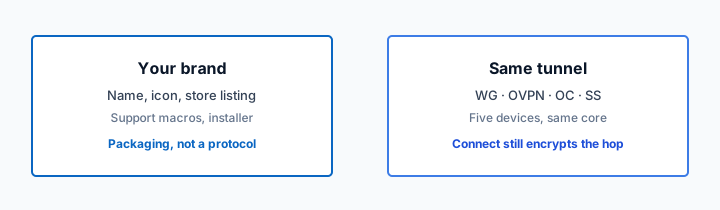
You own the name the user repeats to a friend. You should own checkout, inbox, store listings, and the privacy story. You do not own the physical exits in the sense of racking them yourself. You are on the Klox network. Say that internally so your salespeople do not invent a backbone. Say the right amount externally: enough to be truthful, not so much that you confuse a consumer who only wanted an app that works.
Truthful does not mean dumping a vendor map on the homepage. It means your terms and your security page do not lie.
Sales scripts that do not rot later
Allowed: your brand, your prices, your support, apps the user installs under your name, WireGuard, OpenVPN, OpenConnect, and Shadowsocks in the clients we brand, a money-back policy you actually run. Not allowed: invented audits, invented city counts you did not confirm, 'we beat the big consumer brands in newsrooms.' We will not write that, and you should not either.
Your price is yours
Klox consumer is from $2.83 a month. That is a reference for a finished consumer SKU, not a ceiling or a floor for your brand. If you own the customer, you own the price and the refund math that comes with it. There is a whole piece in this series on not racing to $1.99. Read it before you copy a discount culture you cannot staff.
Contracts that actually move a box
You can contract toward a hybrid: you take first-line support, we take network incidents. You take web checkout, stores stay in your name. You want a DPA that says processor/controller. Good. Put SLAs on the parts that are ours (network) and the parts that are yours (content of the listing, ads, refunds). Do not put a 99.99% uptime sentence on a shared VPN like it was a single-tenant database. Packet networks have weather.
If a clause is vague, assume it will be read against whoever is emotional that week.
Minimum clause set I want in the folder
Merchant of record. Store account ownership. Data roles. Abuse routing. Incident notice. Termination and export. Public claims you may make about the network. Refund interaction (who issues). That is a folder, not a vibe. If your 'agreement' is a WhatsApp thread, you own nothing.
Insurance and who is named
Cyber and E&O policies care about who faces the user. If you are controller and merchant, ask your broker. If you are a reseller, do not assume you have zero exposure; your advice can still be negligent. I am not selling insurance. I am telling you the question exists.
How to pick based on who you want to own
Want a brand you can sell, a store listing you control, and a list you can email? White-label, and accept merchant and controller work. Want speed and no processor KYC drama? Reseller, and accept that you are a channel. Want a private fleet with custom legal terms? /contact, and do not force that into a consumer template.
I do not care which you pick. I care that you pick on purpose. The worst outcome is a reseller who spends like a brand, or a white-label partner who staffs like an affiliate.
A one-page test for your cofounder
Write answers to: Who refunds? Who is on the card? Who is the publisher? Who is the controller? Who deletes an account? Who answers a rights request? Who pulls a node after abuse? If two of you write different names, you are not ready to spend on ads.
A week-one drill I run with new partners
On a call, I ask them to refund a fake user, file a fake rights request, and show me who can push a store hotfix. The teams that can do all three in one hour own the customer. The teams that say 'our vendor handles that' for all three own a slide. Practice the drill before you spend on a launch campaign. It is cheaper than discovering the gaps in week three when a real cardholder is shouting.
I also ask for the mailbox that receives processor mail. If that mailbox is a founder Gmail with 4,000 unread newsletters, we fix that before we talk about city lists. Chargeback deadlines do not wait for inbox zero.
Then go read the money map
Ownership without a cost model is still a toy. The companion piece on white-label versus building from scratch is about where cash goes. This piece is about where liability sits. You need both before you print a launch date.
Key Takeaways
The customer belongs to whoever the bank, the store, the privacy law, and the inbox agree on. If those four disagree, you have a partner diagram, not a company.
Reseller sells Klox. The subscriber is ours. You own a channel. White-label puts your brand on our network. You should own merchant, publisher, controller, and inbox, and you should write that down. Enterprise leftovers go through contact, not through a guess.
If you want the brand-shaped path, talk to us about white-label with the four boxes already filled. If you cannot fill them, start with reseller until you can. That is not a lesser path. It is an honest one.
Related Resources
Own the name. Be honest about the network.
White-label is your brand on the Klox network. Reseller sells Klox. Bring the four boxes: merchant, publisher, controller, inbox.
Talk to us about white-labelFrequently Asked Questions
KloxVPN Team
Experts in VPN infrastructure, network security, and online privacy. The KloxVPN team has been building and operating VPN services since 2019, providing consumer and white-label VPN solutions to thousands of users worldwide.