VPNs and proxies are both tools for routing your internet traffic through an intermediary server, masking your real IP address in the process. That similarity leads many people to treat them as interchangeable. They are not.
The differences between a VPN and a proxy go beyond the technical — they determine what threats each tool actually protects you against, and how reliably. A proxy changes where your traffic appears to come from. A VPN encrypts your traffic and changes where it appears to come from. On public WiFi, that distinction can mean the difference between your credentials being captured and your data remaining unreadable. Both tools route your traffic through a remote server. Only one protects it from interception along the way.
Understanding these differences is essential for making the right choice for your privacy and security needs. This guide breaks down the technical architecture of each, the security implications, and practical recommendations for common scenarios. Whether you are choosing between a free proxy and a paid VPN, or evaluating whether your current setup is adequate, the following sections provide the framework for a sound decision.
Related reading: What Is a VPN and How Does It Work? and Public WiFi Security Risks: What You Need to Know. VPN Reconnect and Kill Switch: Stay Protected When the Connection Drops and VPN Browser Extension vs App: Which to Use. What is a VPN? and Download KloxVPN.
Looking for a reliable VPN?
KloxVPN — from $2.83/month. Apps for every device.
What Is a Proxy?
A proxy server is an intermediary that forwards your requests to websites on your behalf. When you configure a browser to use a proxy, your browser sends requests to the proxy server, which fetches the content and returns it to you. The website sees the proxy's IP address, not yours. The proxy sits between you and the destination — it receives your request, fetches the content from the target site, and sends it back to you. From the website's perspective, the request came from the proxy. From your ISP's perspective, you are connecting to the proxy server. The critical point: the data between you and the proxy is typically unencrypted (unless you use an HTTPS proxy, which only encrypts the browser-to-proxy leg for HTTPS sites).

- 1Skim the seating / order diagram.
- 2Do the numbered steps once on your real network.
- 3Use the FAQ if a sentence was too long.
- 4Follow one related article — not ten tabs.
How to read this page
Types of Proxies
HTTP proxies handle web browser traffic only. SOCKS5 proxies can handle any type of TCP/UDP traffic, making them more flexible. Transparent proxies don't modify traffic at all — they are often used by networks for content filtering. The key limitation of all standard proxies: they do not encrypt your traffic. They change your apparent IP address, but the data itself travels without cryptographic protection.
How Proxies Are Configured
Proxies are typically configured per-application. In a browser, you set the proxy in network settings or use a browser extension. The browser then sends its requests to the proxy server instead of directly to websites. Other applications — your email client, Slack, Spotify — continue using your direct connection unless you configure each one separately. Most apps do not have built-in proxy settings, so the majority of your traffic never touches the proxy.
What Is a VPN?
A VPN creates an encrypted tunnel between your device and a VPN server. All internet traffic from your device — regardless of application — is routed through this tunnel. Unlike a proxy, the VPN operates at the operating system level, not just within a single application. The encryption ensures that even if your traffic is intercepted, it cannot be read.
| Fact | KloxVPN | Not on this page |
|---|---|---|
| Protocols | WireGuard, OpenVPN, OpenConnect, and Shadowsocks | A third invented protocol |
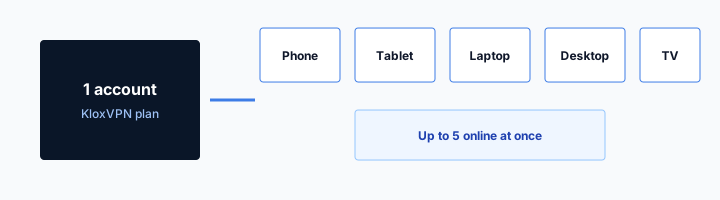
| Devices | Five simultaneous | Unlimited seats |
| Yearly | From $2.83/month | A fake city count |
| Refund | 7-day, first purchase | An On Demand toggle |
System-Wide vs Application-Specific
A VPN intercepts traffic at the network stack — before it reaches any application. Every program on your device — browsers, email clients, games, cloud sync — sends traffic through the VPN tunnel. A proxy, by contrast, only handles traffic from applications explicitly configured to use it. Your browser might use the proxy while your email client sends traffic directly from your real IP.
Encryption Standards
Quality VPNs use AES-256 encryption, the same standard used by governments and financial institutions. The VPN server decrypts your traffic and forwards it to the destination; anyone between you and the server sees only ciphertext. Proxies do not add encryption — they forward your traffic as-is, with only the source IP changed.
Key Differences: VPN vs Proxy
The differences between VPN and proxy become critical when evaluating real-world security scenarios.
vpn vs proxy stays on the box. The hop wrap stays in the app.
— KloxVPN operator notes
Encryption
This is the fundamental difference. A VPN encrypts all traffic using AES-256 or similar standards. A standard proxy does not encrypt traffic at all — it merely forwards it through a different IP address. On public WiFi, a proxy provides no protection against packet sniffing. A VPN renders your traffic unreadable to anyone on the same network. Even if an attacker captures every packet you send, they see only encrypted data. Decryption would require the encryption keys, which never leave your device. This is why VPN is mandatory on public WiFi: the network is inherently hostile, and encryption is the only defense.
Scope of Protection
A proxy typically only protects traffic from the configured application — usually a web browser. Your email client, messaging apps, and other programs continue sending traffic directly from your real IP. A VPN covers all traffic from your device simultaneously, regardless of which app generates it. Background sync, push notifications, and automatic updates all use your real IP when you rely on a proxy. A VPN intercepts traffic at the operating system level, so every application benefits without separate configuration.
Speed and Reliability
Free and public proxies are often slow, unreliable, and may log and sell your traffic. Paid VPN services with dedicated infrastructure are generally faster, more stable, and subject to clear privacy policies. Modern VPN protocols like WireGuard are specifically optimized for low latency. Proxy servers are often overloaded — shared among many users with no quality guarantees. VPN providers invest in server capacity and bandwidth. The difference is noticeable: a quality VPN adds 5-10% latency; a free proxy can add 50% or more, and connections drop frequently. For consistent browsing, streaming, and video calls, a VPN is the reliable choice.
Use Case Fit
A proxy may be sufficient for simple tasks like bypassing a single geo-restriction in a browser when you are on a trusted network and privacy is not a concern. A VPN is the correct tool when encryption, privacy, or protection across all applications is required. The vast majority of users fall into the VPN category: they use public WiFi, value privacy from their ISP, or want protection across multiple apps. If you are unsure which tool fits your needs, default to VPN. The downside of using a VPN when a proxy would suffice is minimal; the downside of using a proxy when a VPN is needed is significant.
When to Use Each
Given the differences above, choosing between a proxy and a VPN comes down to your threat model and use case.
Use a proxy when
You need a quick IP change for a non-sensitive task in a single browser on a trusted network. For example: accessing a geo-restricted website from your home network where traffic security is not a concern. Speed over security is the priority. The scenario is narrow: trusted network (your home, not public WiFi), single application (one browser), non-sensitive task (reading an article, not banking). If any of those conditions change, a VPN is the better choice.
Use a VPN when
You are on a public, shared, or untrusted network. You need to protect traffic from multiple applications. Privacy from your ISP matters. You are in a country with internet censorship. You want encryption and IP masking combined. For almost all practical privacy and security purposes, a VPN is the correct choice. Travelers, remote workers, and anyone who values privacy should default to VPN. The marginal cost over a proxy is small; the protection gain is large.
Proxy and VPN Security Comparison
The security gap between proxy and VPN is significant. Understanding exactly what each protects against helps you avoid false confidence.
Traffic Interception
On public WiFi, an attacker with packet sniffing tools can capture unencrypted traffic. A proxy sends your requests in plaintext — the attacker sees exactly which sites you visit and can capture credentials and session cookies. A VPN encrypts everything before it leaves your device; captured packets are unreadable. The difference is not theoretical. Security researchers routinely demonstrate packet sniffing on public networks; tools like Wireshark are freely available. Without encryption, your traffic is exposed the moment it leaves your device.
DNS and Metadata Leaks
Proxies often leave DNS queries unencrypted. Your ISP and anyone on the network can see which domains you resolve, even if the proxy hides your IP from the destination. VPNs typically route DNS through the encrypted tunnel, preventing DNS leaks. DNS reveals which sites you visit — every domain name you type or that an app requests is resolved through DNS. With a proxy, those queries may go directly to your ISP or the network's DNS server. With a VPN, DNS queries are encrypted and sent through the tunnel to the VPN provider's DNS servers. Your ISP cannot see your DNS activity when the VPN is connected.
Trust in the Intermediary
Both proxy and VPN operators can see your traffic. With a proxy, traffic is unencrypted to them — they can log everything. With a VPN, traffic is encrypted to the VPN server; a no-logs VPN retains nothing. The trust model differs: proxy operators often monetize by logging; reputable VPNs commit to not logging. Free proxy services have been caught injecting ads, redirecting traffic, and selling user data. Paid VPNs with audited no-logs policies have a business model based on subscriptions, not data monetization. When you use a proxy, you are trusting the operator with your unencrypted traffic. When you use a no-logs VPN, the operator cannot produce your data even if compelled — they do not have it.
Niche Use Cases Where Proxies Make Sense
There are legitimate scenarios where a proxy is the appropriate tool rather than a VPN.
Web Scraping and Automation
Developers running automated scripts may need to rotate IP addresses at scale. Proxy pools offer thousands of IPs at lower cost than VPN infrastructure. For non-sensitive scraping where encryption is not required, proxies are practical. The use case is specific: automated data collection from public sources, testing geo-targeted content, or bypassing rate limits. For any activity involving personal data, credentials, or sensitive information, a VPN is the correct choice.
Single-Application IP Change
If you need to change your IP for one browser-based task on a trusted network — testing geo-targeted content, accessing a region-locked article — a browser proxy extension can suffice. The key: trusted network, non-sensitive task, single application. Developers testing location-based features or marketers checking regional ad campaigns might use a proxy for quick IP rotation. The risk is low because the network is trusted and the activity is not sensitive. For anything beyond that narrow use case, a VPN is the safer default.
Corporate and Enterprise Proxies
Some organizations use proxies for content filtering, caching, or compliance logging. These are typically transparent proxies that users do not choose — different from the consumer proxy vs VPN decision.
VPN vs Proxy: Side-by-Side Comparison
A quick reference for the key differences. Use this when deciding which tool fits your needs.
Encryption and Privacy
VPN: Encrypts all traffic. Protects against packet sniffing, ISP logging, and man-in-the-middle attacks. Proxy: No encryption. Traffic is visible to anyone who can intercept it. Your ISP, the network operator, and attackers on the same network can see what you do.
Scope of Protection
VPN: Protects every app on your device — browser, email, games, background sync. One connection secures everything. Proxy: Typically browser-only. Other apps bypass the proxy entirely. You would need to configure each application separately, and many apps do not support proxy configuration.
Cost and Reliability
VPN: Paid services ($3-10/month) offer dedicated infrastructure, no-logs policies, and support. Free VPNs exist but often log or limit usage. Proxy: Free proxies are common but risky — many log and sell data. Paid proxy services exist for specific use cases (scraping, automation) but are not designed for consumer privacy. For the price of a coffee per month, a quality VPN provides encryption, device-wide protection, and a clear privacy policy. The cost barrier is low; the protection gain is high.
Making the Switch: Proxy to VPN
If you currently use a proxy for privacy, migrating to a VPN is straightforward. The mental model is similar — you route traffic through an intermediary — but the implementation and protection level differ significantly.
What Changes When You Switch
You install an app instead of configuring browser settings. You connect with one tap instead of enabling a proxy. All your apps are protected automatically instead of just the browser. The VPN runs in the background; you do not need to remember to enable it for each session. Auto-connect on untrusted networks means the VPN activates whenever you join public WiFi — no manual step required. The kill switch adds a safety net if the connection drops. These features are standard in VPN apps but not available with proxy configuration.
Migration Steps
Download a VPN app from a reputable provider. Create an account and subscribe. Install on each device you use. Enable the kill switch and auto-connect on untrusted networks. Disable or remove your previous proxy configuration. Test that your IP changes when connected. The entire process takes under 15 minutes per device. After migration, verify your setup: visit whatismyip.com to confirm your IP changes when the VPN connects, run a DNS leak test to ensure DNS goes through the VPN, and test on public WiFi to confirm the kill switch blocks traffic when disconnected.
When a Proxy Is the Wrong Choice
Certain scenarios make proxy use actively dangerous. If any of these apply, use a VPN instead.
Public WiFi and Shared Networks
On cafe, airport, or hotel WiFi, unencrypted traffic can be captured by anyone on the network. A proxy sends your traffic in plaintext. A VPN encrypts it. There is no exception: public WiFi requires encryption. A proxy provides none. Packet sniffing tools are freely available; attackers do not need advanced skills to capture traffic on a shared network. The only defense is encryption at the source — which a VPN provides and a proxy does not. Using a proxy on public WiFi gives you a false sense of protection while leaving your credentials and session data exposed.
Sensitive Accounts and Banking
Banking, work email, and accounts with payment information should never traverse an unencrypted proxy. Even if the destination uses HTTPS, your DNS queries and connection metadata can leak. A VPN encrypts the full path. HTTPS encrypts the content between you and the website, but your ISP and anyone on your network can still see that you are connecting to a bank. With a proxy, the proxy operator sees your full traffic. With a VPN, the entire path is encrypted. For financial transactions and confidential communications, use a VPN — never a proxy.
Countries with Surveillance or Censorship
In regions with government surveillance or internet restrictions, unencrypted proxy traffic is visible to network operators. VPN encryption makes traffic unreadable. Some countries block VPNs; in those cases, obfuscated protocols like Shadowsocks may work where standard VPNs fail. A proxy does not help. Government surveillance systems use deep packet inspection to identify and log traffic. Unencrypted proxy traffic is trivially identifiable. A VPN with strong encryption presents only ciphertext — the content cannot be inspected. If you are in a high-surveillance environment, encryption is non-negotiable.
How a tunnel applies to VPN vs Proxy: What's the Difference and Which One Should You Use?
Leak tests belong after Connect, not while the VPN vs Proxy: What's the Difference and Which One Should You Use? sign-in page is still painting. If the page loops after you already connected, drop the tunnel, finish the garden, connect again. Do not reboot the phone first. When the AP filters UDP, OpenVPN often still lands. When both fail, the WAN is the problem, not a missing VPN vs Proxy: What's the Difference and Which One Should You Use? mode. If UDP dies on VPN vs Proxy: What's the Difference and Which One Should You Use? APs, one protocol swap. Then stop tinkering.
Someone else owns the AP on VPN vs Proxy: What's the Difference and Which One Should You Use? networks. Guest SSIDs still NAT you. That is the whole physics lesson. If the SSID looks like staff Wi-Fi, still assume a portal. Fancy names do not grant a private backbone. Cookies: /cookie. That is this website. It is not the tunnel and not the portal. Treat VPN vs Proxy: What's the Difference and Which One Should You Use? like a hotel SSID even when the branding looks official.
VPN vs Proxy: What's the Difference and Which One Should You Use? Wi-Fi is still a LAN you do not run. {place} is a location, not a protocol. Inner DNS through the tunnel is the setting you wanted. The LAN seeing a blob to a node is success. [Captive portal]({portal}) is the garden. VPN is the truck after. Mix the order and you get a loop or a leak, not a new feature. Send this slug when someone asks for a special VPN vs Proxy: What's the Difference and Which One Should You Use? profile. There is not one.
The hop wrap here
I will not invent a dashboard row named VPN vs Proxy: What's the Difference and Which One Should You Use?. Consumer facts stay boring: five devices, WireGuard, OpenVPN, OpenConnect, and Shadowsocks, 7-day money-back on first purchase. A QR code next to the kettle is still HTTP to a portal. It is not Connect. Finish it. Do not run leak tests during sign-in. The portal has to see you. That is the point of the garden. Apps at /download. Plans at /pricing. Garden in the browser. Tunnel in the app.
If you came here looking for a VPN vs Proxy: What's the Difference and Which One Should You Use? mode in Settings: there is not one. Same apps. Same WireGuard, OpenVPN, OpenConnect, and Shadowsocks. A minute of waiting after join is normal while DHCP and the garden load. Do not mash Connect ten times. If WireGuard hangs for a minute on VPN vs Proxy: What's the Difference and Which One Should You Use? Wi-Fi, wait out the portal, confirm you have a WAN, then try OpenVPN once. No VPN vs Proxy: What's the Difference and Which One Should You Use? mode. Same apps. Same five devices. Same yearly $2.83/mo on yearly.
The SSID string is marketing on the AP. The tunnel is WireGuard, OpenVPN, OpenConnect, and Shadowsocks. Keep those sentences in different rooms. Hotel, airport, campus, VPN vs Proxy: What's the Difference and Which One Should You Use?: same NAT story. You are a guest. Guests get wrapped after sign-in. Five devices means five. It does not mean a VPN vs Proxy: What's the Difference and Which One Should You Use? site license. Share the account inside that cap. Portal first. Handshake second. Leak test third. That is the whole checklist.
Related product pages
You do not need a special build because the SSID says VPN vs Proxy: What's the Difference and Which One Should You Use?. You need the same Klox app you would use at a cafe. Phone hotspot versus VPN vs Proxy: What's the Difference and Which One Should You Use? AP is the same ritual with a different radio. Untrusted, then wrap. Inner packets stay inner. Outer header goes to a node. VPN vs Proxy: What's the Difference and Which One Should You Use? NAT still exists. You wanted that. You are done when Connect is up and the portal is in the past. Not when you renamed a sysctl.
UDP can die on rude APs that happen to be labeled VPN vs Proxy: What's the Difference and Which One Should You Use?. Switch to OpenVPN once. Do not stack three clients. Leak sites during the garden will look broken. They are supposed to see you. Test after Connect. See Cloudflare's VPN explainer if you need the noun. The SSID can say VPN vs Proxy: What's the Difference and Which One Should You Use? or Coffee. The noun does not change. VPN vs Proxy: What's the Difference and Which One Should You Use? Wi-Fi is shared. Finish the portal. Then WireGuard, OpenVPN, OpenConnect, and Shadowsocks.
Shared VPN vs Proxy: What's the Difference and Which One Should You Use? Wi-Fi is not your network even when the SSID looks friendly. Assume NAT. Assume a garden. Then wrap. When UDP dies, one OpenVPN attempt is the spare tire. A third client is how you create two default routes. A QR by the kettle is still a captive garden. Finish it. Then Connect. Then test leaks if you care. The SSID label does not change the physics. Wrap after sign-in.
Key Takeaways
The core distinction: a proxy hides your IP for specific application traffic without encrypting it. A VPN encrypts all traffic from your entire device while also masking your IP. For casual IP switching on trusted networks, a proxy can be sufficient. For any scenario involving security — public WiFi, sensitive accounts, or privacy from surveillance — a VPN is the only appropriate tool.
When in doubt, choose a VPN. The cost difference between a quality VPN and a paid proxy is minimal for consumers. The protection difference is substantial. A VPN gives you encryption, device-wide coverage, and a clear privacy policy. A proxy gives you IP masking for a subset of your traffic — and nothing more.
If you currently use a proxy for privacy, consider switching to a VPN. The setup is similar — install an app, connect — but the security model is fundamentally different. Your traffic deserves encryption, not just a different IP address.
Related Resources
Get Full Encryption — Not Just IP Masking
KloxVPN provides AES-256 encryption across all your devices. WireGuard, OpenVPN, Shadowsocks — built in.
View KloxVPN PlansFrequently Asked Questions
KloxVPN Team
Experts in VPN infrastructure, network security, and online privacy. The KloxVPN team has been building and operating VPN services since 2019, providing consumer and white-label VPN solutions to thousands of users worldwide.